
Freon refrigeration systems, using hydrofluorocarbon (HFC) or hydrochlorofluorocarbon (HCFC) refrigerants, have been a mainstay of industrial and commercial cooling for decades. Known for their reliability, versatility, and relatively simple maintenance, Freon systems are widely used in medium-scale industrial facilities, commercial buildings, cold storage warehouses, and food and beverage production plants.
At TIESA, we design, install, and maintain custom Freon refrigeration systems tailored to the operational needs of your facility. Our solutions provide energy efficiency, operational reliability, and safety, while helping businesses meet their cooling and regulatory requirements.
While newer natural refrigerants such as ammonia and CO₂ are gaining popularity, Freon remains a trusted choice for medium-capacity industrial applications, especially where lower installation complexity and proven technology are priorities.
Freon refers to a family of chlorofluorocarbon (CFC), hydrochlorofluorocarbon (HCFC), or hydrofluorocarbon (HFC) refrigerants. Commonly used Freon types in industrial and commercial applications include:
Freon refrigerants work in a mechanical vapor-compression cycle, absorbing heat from the cooled space and releasing it into the environment.
Advantages of Freon refrigeration systems include:
Freon refrigeration operates on a closed-loop vapor-compression cycle similar to ammonia and CO₂ systems, but with refrigerants that are non-toxic and non-flammable:
| 1. Evaporation | 2. Compression | 3. Condensation | 4. Expansion |
Freon refrigeration systems, using hydrofluorocarbon (HFC) or hydrochlorofluorocarbon (HCFC) refrigerants, have been a mainstay of industrial and commercial cooling for decades. Known for their reliability, versatility, and relatively simple maintenance, Freon systems are widely used in medium-scale industrial facilities, commercial buildings, cold storage warehouses, and food and beverage production plants. At TIESA, we design, install, and maintain custom Freon refrigeration systems tailored to the operational needs of your facility. Our solutions provide energy efficiency, operational reliability, and safety, while helping businesses meet their cooling and regulatory requirements. While newer natural refrigerants such as ammonia and CO₂ are gaining popularity, Freon […] Liquid Freon enters the evaporator at low pressure, absorbing heat from the refrigerated space or product and vaporizing. | The Freon vapour is compressed, increasing its temperature and pressure, preparing it for heat rejection. | High-pressure Freon vapour flows through a condenser, releasing heat to the ambient environment and condensing back into liquid. | The liquid Freon passes through an expansion valve, reducing pressure and temperature before returning to the evaporator, completing the cycle. This cycle enables consistent and reliable cooling for industrial and commercial applications. |
| 1. Proven Reliability | 2. Ease of Maintenance | 3. Safety | 4. Flexibility in System Design | 5. Moderate Energy Efficiency |
| Freon refrigeration has been used for decades, providing consistent, dependable cooling for industrial facilities, commercial buildings, and cold storage operations. | Freon systems are widely understood by technicians and require relatively simple maintenance, making ongoing operation cost-effective. | Freon refrigerants are non-toxic and non-flammable, providing safer operation compared to ammonia. | Freon refrigeration systems can be installed as: Single-compressor systems for medium-scale applications Multiple-compressor systems for larger facilities Cascade systems when combined with natural refrigerants for low-temperature applications | While Freon refrigerants are not as energy-efficient as ammonia or CO₂ for large-scale operations, proper system design, variable-speed compressors, and advanced controls can optimize energy performance, reducing operational costs. |
1. Food Processing
Freon refrigeration ensures consistent product quality and safe temperature control for:
Freon systems are ideal for medium-capacity cooling operations where ammonia may be overkill.
2. Cold Storage Warehouses
Freon systems are used to maintain stable temperatures in commercial and industrial storage facilities, ensuring:
3. Beverage Production
Freon refrigeration supports beverage manufacturing, including breweries, wineries, and soft drink plants, by:
4. Commercial and Office Buildings
Freon systems are commonly used for air conditioning and climate control in commercial offices, shopping centres, and industrial facilities, offering reliable cooling without the complexity of ammonia or CO₂ systems.
5. Specialty and Hybrid Applications
Freon refrigeration can be integrated into hybrid systems with CO₂ or ammonia for low-temperature processes, providing flexibility and safety.
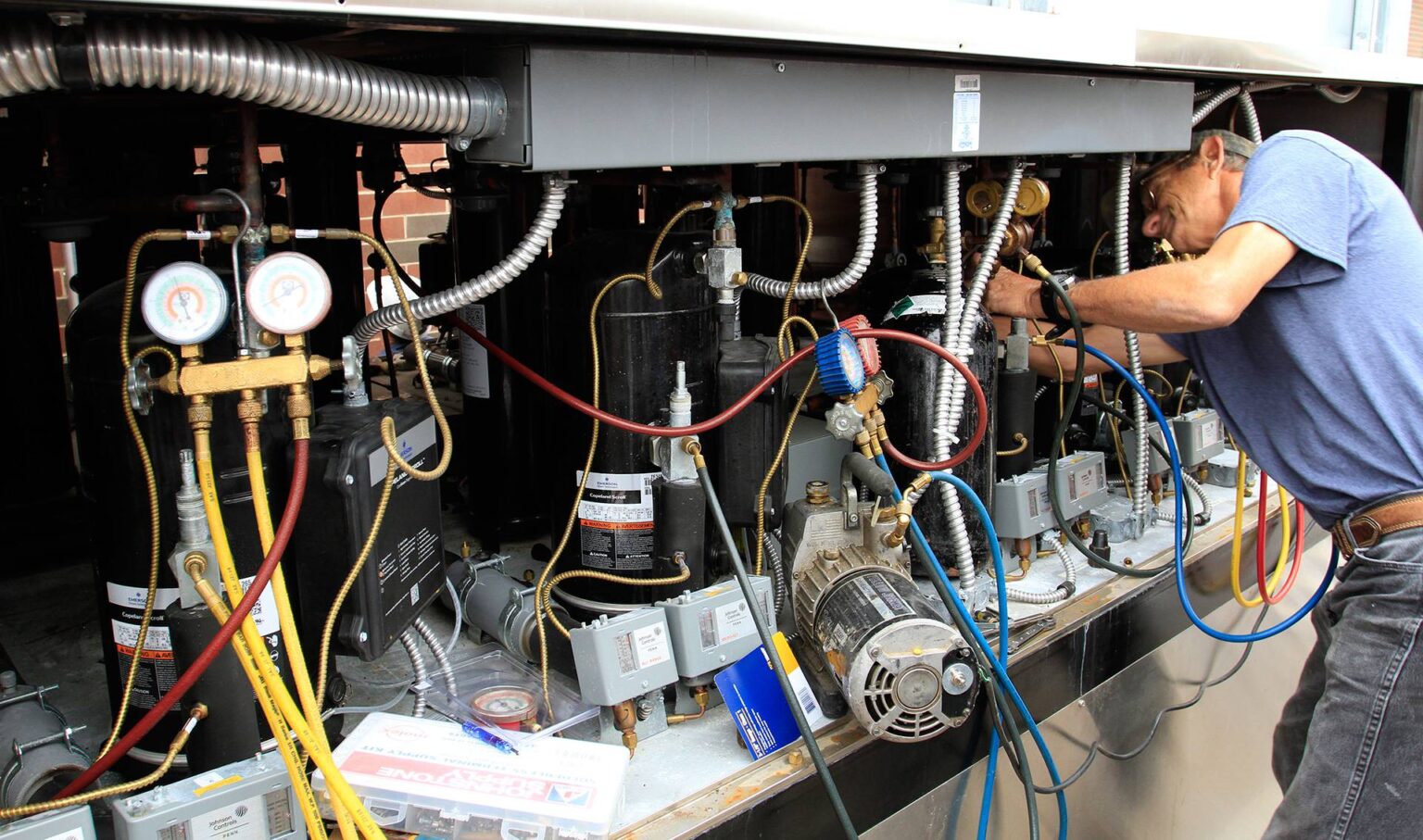
Compressors: Drive the refrigeration cycle and regulate cooling capacity
Condensers: Remove heat from the refrigerant
Evaporators: Absorb heat from cooled spaces or products
Piping and Valves: Transport Freon efficiently and safely
Control Panels & Automation Systems: Monitor system operation and optimize efficiency
Safety Devices: Include pressure relief valves, alarms, and emergency shutdowns
| Feature | Freon (HFC/HCFC) | Ammonia (NH₃) | CO₂ (R-744) |
| Environmental Impact | Moderate-High | Very Low | Very Low |
| Safety | Non-toxic | Toxic, flammable | Non-toxic |
| Energy Efficiency | Moderate | Very High | Moderate-High |
| Industrial Capacity | Medium | Very High | Medium-High |
| Maintenance | Moderate | Low if proper | Moderate |
| System Complexity | Moderate | High | Moderate |
Freon refrigeration is a practical choice for facilities where safety, ease of maintenance, and moderate energy efficiency are priorities.
Although Freon systems are generally less energy-efficient than ammonia or CO₂ in large-scale applications, proper design and technology integration can significantly improve performance:
Example ROI: A medium-sized cold storage facility using Freon can achieve 10–15% energy savings with optimized compressor and system management.
At TIESA, our custom engineering approach ensures Freon systems meet operational needs:
This ensures that Freon refrigeration systems operate efficiently and reliably for years.
Freon systems require regular preventive maintenance:
With proper maintenance, Freon systems can provide 15–25 years of reliable service, depending on usage and operational conditions.
Q1: Is Freon refrigeration safe?
Yes, Freon is non-toxic and non-flammable, making it safe for commercial and industrial applications.
Q2: How energy-efficient is Freon?
Moderate, but system optimization and advanced controls can improve efficiency by 10–15%.
Q3: Which industries benefit most?
Food processing, cold storage, beverage production, commercial facilities, and hybrid industrial applications.
Q4: How long do Freon systems last?
Typically 15–25 years with proper preventive maintenance.
Q5: Can Freon integrate with ammonia or CO₂?
Yes, Freon is commonly used in hybrid systems for low-temperature processes.
Q6: How environmentally friendly is Freon?
Modern HFC refrigerants have lower ozone depletion than legacy CFCs, but GWP is higher than natural refrigerants. Proper system management is essential.
Q7: How often should Freon systems be serviced?
Preventive maintenance should occur at least twice per year, with continuous monitoring.
Q8: Can Freon systems be scaled?
Yes, they are flexible for medium-capacity industrial and commercial applications.
Q9: What are common applications for Freon refrigeration?
Food, beverage, cold storage, commercial buildings, and specialty industrial processes.
Q10: What safety features are included?
Pressure relief valves, alarms, emergency shutdown systems, and automated monitoring.
GET IN TOUCH