
Spiral freezers are advanced industrial freezing systems designed for continuous high-capacity freezing operations. Unlike conventional batch freezers, spiral freezers maximize space efficiency, improve throughput, and maintain consistent product quality, making them ideal for food processing plants, meat and seafood facilities, bakeries, and dairy production.
At TIESA, we design, install, and maintain custom spiral freezers tailored to your operational needs. Our solutions provide energy-efficient, reliable, and scalable freezing, enabling businesses to improve productivity, reduce product waste, and maintain strict temperature control.
With increasing demand for frozen foods and the need for sustainable, energy-efficient operations, spiral freezers are becoming a critical investment for industrial and commercial food production.
A spiral freezer is a continuous conveyor-based freezing system in which products move through a spiral-shaped belt, passing through multiple cooling zones. The design allows:
Spiral freezers can use air blast refrigeration or cryogenic freezing techniques, depending on product requirements and desired throughput.
Common industries using spiral freezers include:
Spiral freezers operate using a continuous conveyor system, which circulates products through controlled freezing zones:
1. Product Loading
Products are loaded onto the conveyor, typically in trays, baskets, or directly on a belt, depending on their size and packaging.
2. Spiral Conveyor Movement
The conveyor moves products through multiple levels of the spiral, increasing the freezing time without requiring excessive floor space.
3. Freezing Zones
Each level of the spiral is exposed to controlled cooling air or cryogenic gases, maintaining a consistent temperature gradient to ensure uniform freezing.
4. Product Discharge
Frozen products exit the spiral freezer at the bottom or side, ready for packaging, storage, or further processing.
This design allows high-capacity continuous freezing with minimal energy loss and space efficiency, ideal for industrial operations.
1. High Capacity and Throughput
Spiral freezers can handle large volumes of products in a continuous process, increasing productivity without the need for multiple batch freezers.
2. Space Efficiency
The vertical spiral design allows maximizing floor space, making spiral freezers suitable for facilities with limited space or multiple processing lines.
3. Uniform Freezing
Controlled airflow and spiral movement ensure consistent freezing across all products, reducing waste and maintaining product quality.
4. Energy Efficiency
Spiral freezers can reduce energy consumption by:
Energy-efficient designs help reduce operational costs and environmental impact.
5. Versatility
Spiral freezers can freeze a wide range of products, including:
6. Integration with Production Lines
Spiral freezers can be fully integrated with upstream processing equipment, such as slicing, forming, or portioning machines, and downstream packaging lines, ensuring smooth production flow.
1. Meat, Poultry, and Seafood Processing
2. Bakery Products
3. Dairy Products
4. Ready-to-Eat and Frozen Foods
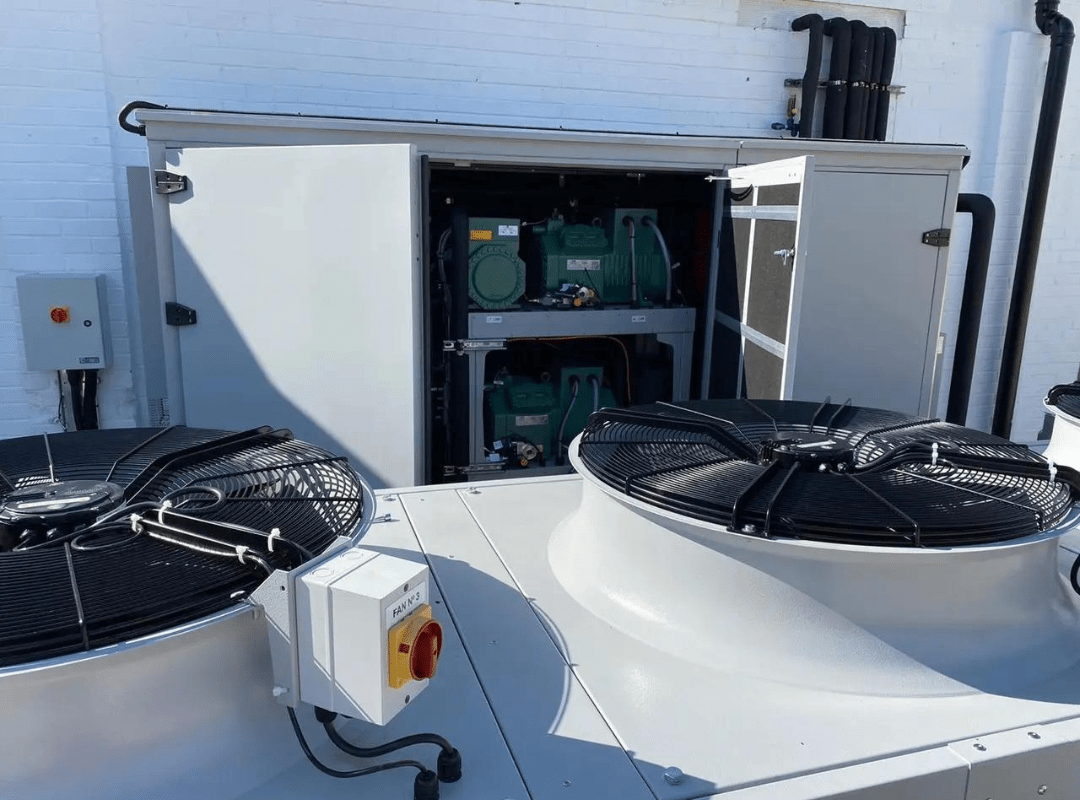
Conveyor System: Stainless steel belts or modular chain conveyors
Cooling System: Air blast refrigeration or cryogenic systems using CO₂ or liquid nitrogen
Fans and Ducts: Ensure uniform airflow and consistent freezing
Control Panels & Automation: Monitor temperatures, conveyor speed, and system performance
Insulated Housing: Maintain internal temperatures and reduce energy loss
Safety Devices: Emergency stops, alarms, and ventilation systems
Spiral freezers offer energy-efficient freezing through:
Example ROI: A medium-sized seafood processing facility can achieve 15–25% energy savings with a modern TIESA spiral freezer compared to traditional batch freezers, while doubling throughput.
TIESA designs spiral freezers using a custom engineering approach:
Our designs ensure high throughput, energy efficiency, and reliable operation tailored to each facility.
Proper maintenance ensures spiral freezers operate efficiently:
With routine maintenance, spiral freezers can operate reliably for 20+ years, providing long-term value and operational efficiency.
| Feature | Spiral Freezer | Batch Freezer | Tunnel Freezer |
| Throughput | Very High | Medium | High |
| Floor Space Efficiency | Excellent | Low | Medium |
| Product Quality | High | Medium | High |
| Energy Efficiency | High | Medium | High |
| Integration Capability | Excellent | Low | Medium |
Spiral freezers are ideal for high-capacity continuous production, while batch freezers are better for small-scale operations, and tunnel freezers suit medium-to-high-volume products.
Q1: What products can be frozen in a spiral freezer?
Meat, poultry, seafood, bakery, dairy, ready-to-eat meals, and specialty foods.
Q2: How much floor space is needed?
Minimal, due to vertical spiral design, making them ideal for space-constrained facilities.
Q3: How fast can products be frozen?
Depending on the system, products can be frozen in minutes to hours, depending on size and cooling method.
Q4: Are spiral freezers energy-efficient?
Yes, modern spiral freezers use optimized airflow, variable-speed conveyors, and efficient refrigeration to reduce energy consumption.
Q5: Can spiral freezers integrate with production lines?
Yes, they can connect with slicing, portioning, forming, packaging, and storage lines for continuous operation.
Q6: What maintenance is required?
Regular inspection, cleaning, lubrication of moving parts, and refrigeration system checks.
Q7: How long do spiral freezers last?
Typically 20+ years with proper maintenance.
Q8: Are spiral freezers safe to operate?
Yes, they include emergency stops, alarms, ventilation, and automated monitoring for operator safety.
Q9: Can cryogenic or air-blast systems be used interchangeably?
Yes, system selection depends on product type, freezing speed requirements, and operational cost considerations.
Q10: How do spiral freezers improve product quality?
Uniform freezing prevents ice crystal formation, maintains texture, flavor, and appearance, and extends shelf life.
GET IN TOUCH